I love counting things. Well, sort of. Yes I love counting, but I mostly love the process of finding a way to creatively estimate the total population size of things that are nearly impossible to count. Sometimes it’s the seeds on a cottonwood or the snow geese in a field, and sometimes, like this week, it’s counting the total number of crows in their winter roost…
Counting big groups of things
The past few years I’ve been tasked with estimating the size of the Burlington crow roost for the Winter Bird Count. This year, a small but dedicated group of us braved the cool winds to track down the crows. It was harder than expected and we eventually split up the group. By chance, we stumbled across the roost in an unexpected spot: a patch of trees between Casavant and Combat Fitness in Winooski (map). Hunting down the roost is always a fun process, but estimating the roost size feels like an exercise in futility. Definitely in the thousands, but getting a more precise estimate feels wildly inaccurate for a few reasons:
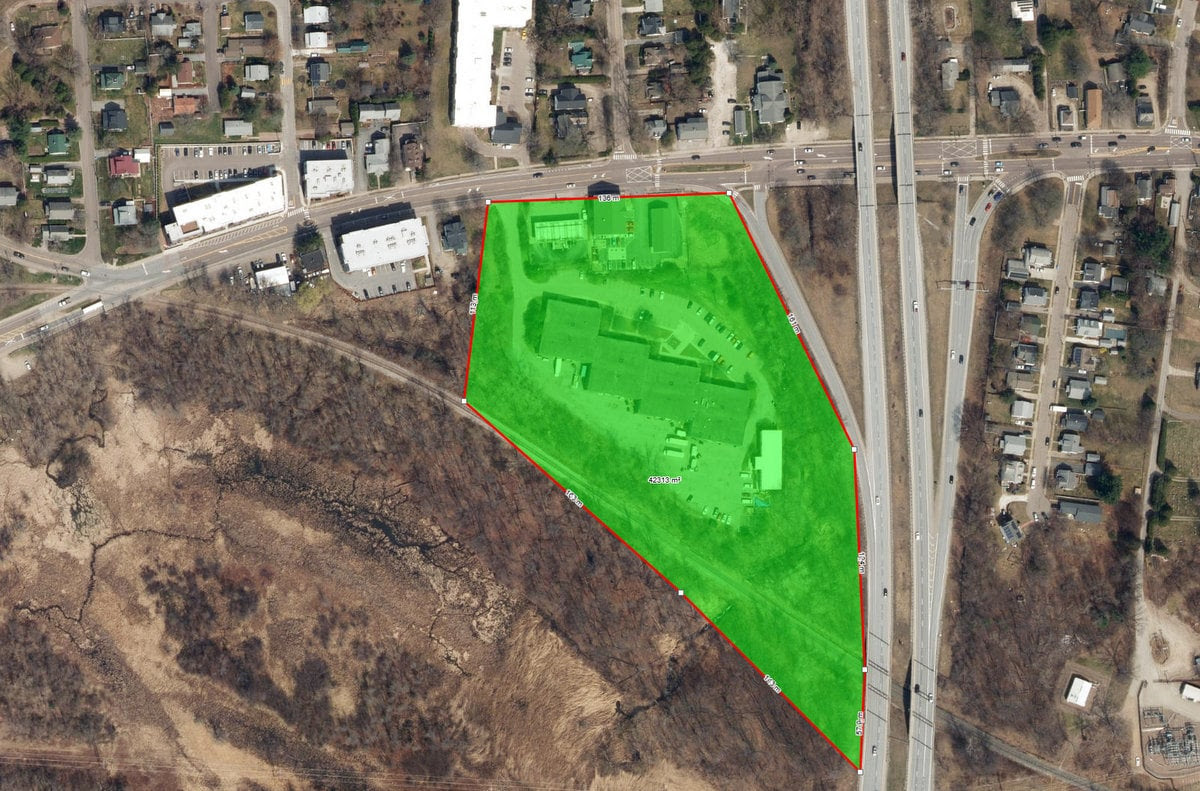
Area: The crows are typically spread out over a pretty broad area. When we first arrived, the roost was concentrated in an area about 10 acres in size. But there were constantly groups of hundreds of birds that would fly in and out of the central part of the roost.
Trees: Because the crows are so spread out, there are plenty of obstacles – trees, buildings, more trees, interstate overpasses – that block any line of sight from seeing all the crows at any one point in time.
Dark: The crows begin to arrive in the rough location of their nightly roost an hour or so before sunset. By the time the majority of crows have arrived, it’s dark out and it’s hard to see much of anything.
They move: It’s not until well after dark that the crows can be described as something approaching settled. Before that, they’re constantly bouncing from tree to tree, doing wild acrobatic displays. You count one group and by the time you get to the next one the first group has already moved on and mixed in with the third and fourth groups
Refining the setup
But all is not lost. There are still a couple of approaches I use for getting a sense of the number of crows:
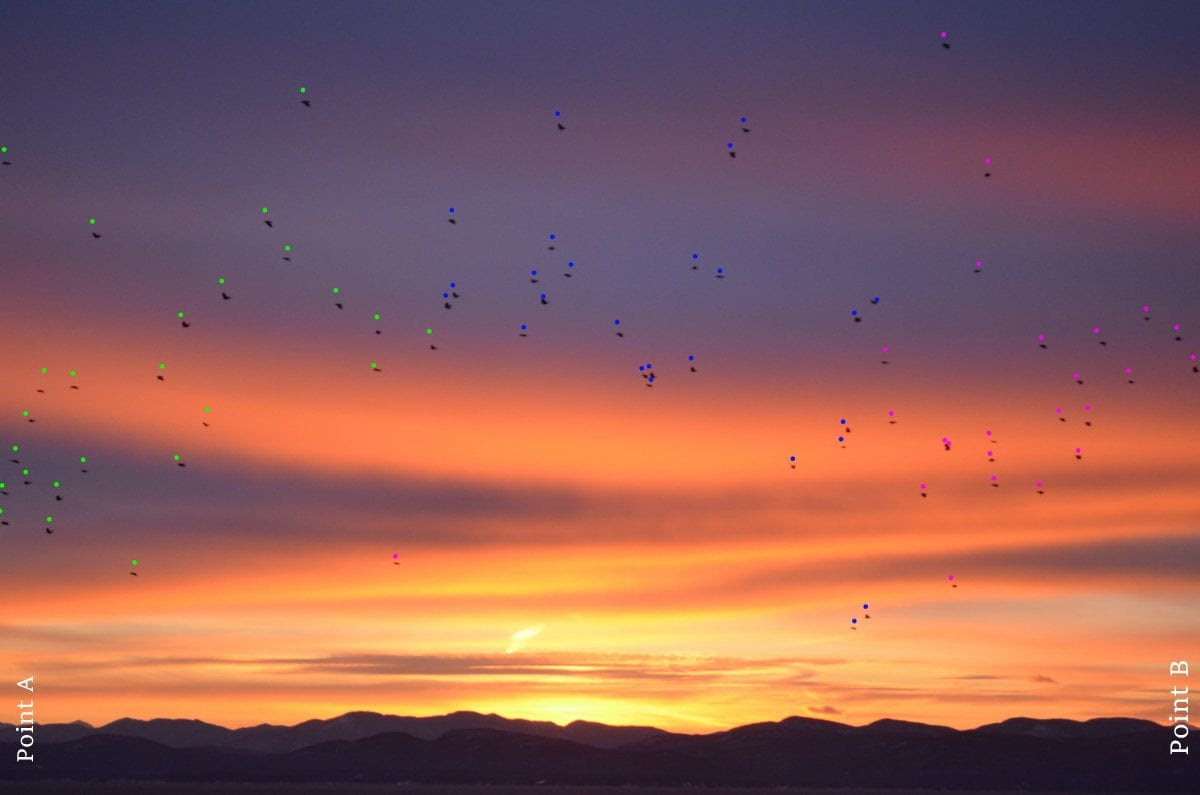
Point to point: When a large flock of crows is traveling to the roost, I’ll pick two points as reference markers. I then time how long it takes for a single crow to travel from point A to B. Next, I’ll count the number of crows between point A and B at any given point (photos help for this). If I time how long it takes for the entire flock to pass through the two gates, I can get a rough sense of the total flock size.
So in the image above there are 74 crows (color groups are in bunches of 25) in the photo. It took each crow about 30 seconds to fly from one end of the frame to the other, and it took the entire flock of crows about 20 minutes from when the first crow passed point A to when the last crow flew by. So every 30 seconds 74 crows fly through the frame and this happened for 20 minutes, or about 2,960 crows in the flock.
But this was just one group of crows flying on their way to meet up with the rest of the roost. Counting crows at the roost relies on trees and some pretty rough estimates.
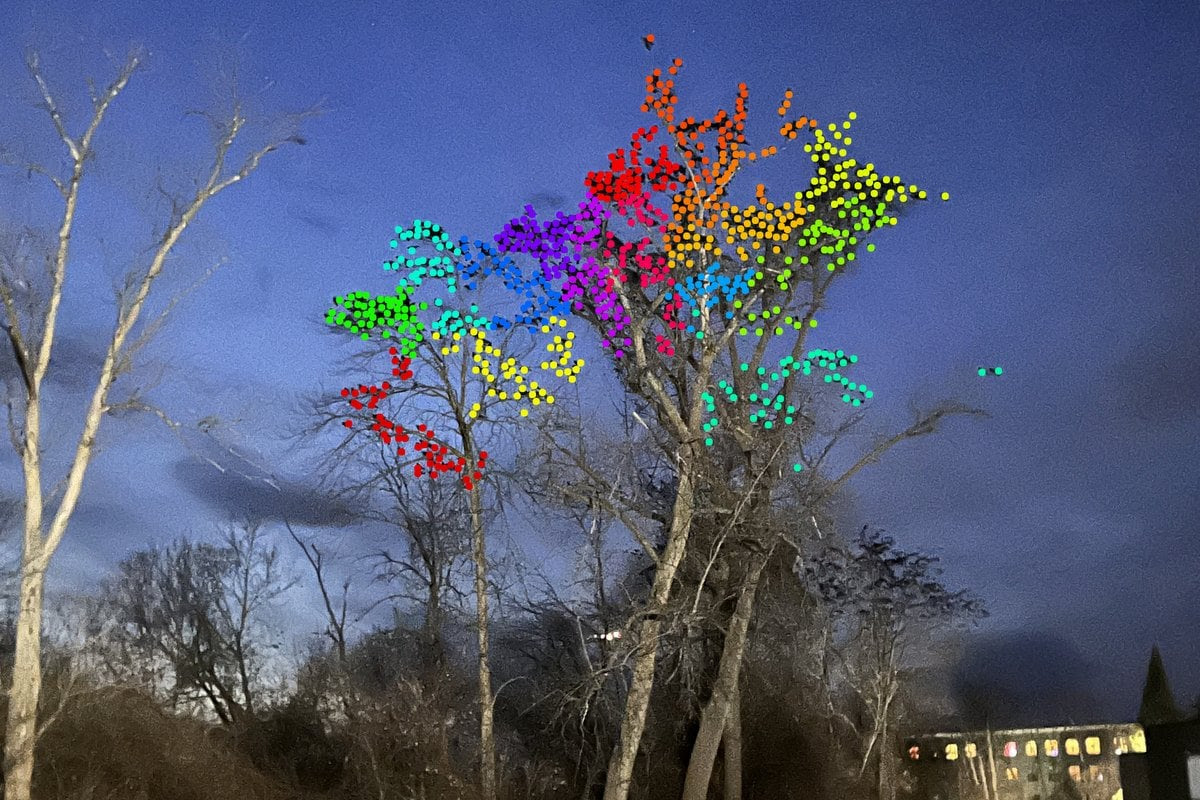
Tree method: When the crows are clustered in a relatively small area, I’ll count the number of crows on a single tree (this usually averages between 100 and 200 birds). I’ll then get a rough estimate of the number of trees that have crows in them and multiply the two numbers together. This method mostly works when the crows have largely settled and there aren’t as many flying around bouncing from tree to tree.
Sunday was particularly challenging because the roost was just so restless. Around 4:50pm, about 75% of the total roost up and flew off towards Burlington. That made it somewhat manageable to get an estimate of the number of crows that stayed behind as there were just three groups of trees with crows clustered in them.
I didn’t do this in the field, but took advantage of a photo Markus Thali sent me after the safari. I used colored dots to mark each bird and used a different color for each group of 50. On the group of trees in the foreground, there are about 785 crows. There’s were two other groups of trees at that time that seemed to have roughly the same number of crows in them, which would give us 2,355 total crows.
Again, this was less than a quarter of the total roost size. So on the conservative end we had maybe 2,355 crows here and another 5,000 to 7,000 crows that had already flown off. Again, it is a highly imprecise method, so if anyone has any better ideas, I’m all ears!